
Introduction
The narrative that “AI will replace humans” generates headlines, but it fundamentally misrepresents how successful organisations are actually deploying artificial intelligence. What consistently drives superior outcomes is an AI strategy focusing on human-AI collaboration, deliberately designed partnerships that harness complementary strengths rather than pursuing wholesale automation. This collaborative intelligence approach doesn’t just boost productivity; it creates adaptive, resilient systems that outperform either humans or AI working in isolation.
According to a landmark study from MIT Media Lab’s NANDA Initiative (2025), nearly 95% of enterprise AI pilots fail to deliver measurable business value. The report, “The GenAI Divide: State of AI in Business 2025” based on analysis of 300+ AI implementations shows that only one in twenty AI projects make it into production with real impact. The report highlights a myth that Generative AI is Transforming Business in reality adoption is high, but transformation is rare. Only 5% of enterprises have AI tools integrated in workflows at scale and 7 of 9 sectors show no real structural change. This underscores why human-AI collaboration is essential for translating AI hype into organisational excellence and value.
The Evidence: Collaborative Intelligence Delivers Measurable Results
Recent comprehensive research across multiple industries provides compelling evidence for human-AI collaboration’s transformative potential. Studies demonstrate consistent productivity gains when humans and AI work together strategically.
Productivity Breakthroughs Across Industries
In a rigorous field experiment with 758 consultants at Boston Consulting Group, those using AI completed 12.2% more tasks and worked 25.1% faster than their non-AI counterparts. Most remarkably, output quality improved by more than 40% compared to control groups (Dell’Acqua et al., 2023). The study revealed what researchers term the “jagged technological frontier”, AI excels at certain tasks whilst humans remain superior at others, making collaboration essential for optimal performance.
Customer service operations show even more dramatic results. Analysis of 5,000 agents revealed that AI-assisted teams resolved 14% more issues per hour, with the greatest benefits flowing to newer employees (Brynjolfsson, Li, & Raymond, 2023). This pattern of AI-enabled skill equalisation appears consistently across studies, less experienced workers gain disproportionately from AI augmentation, whilst experts maintain their edge through enhanced capabilities.

The Hybrid Intelligence Advantage
What makes these partnerships so effective? The answer lies in hybrid intelligence systems, sociotechnical frameworks that combine human cognitive strengths with machine computational power. Recent research defines hybrid intelligence as “the ability to accomplish complex goals by combining human and artificial intelligence to collectively achieve superior results than each could accomplish separately”(Dellermann, Ebel, Söllner, & Leimeister, 2019)(Akata et al., 2020).
These systems succeed because they allocate tasks based on complementary capabilities. Humans excel at contextual judgement, ethical reasoning, creative problem-solving, and adapting to unexpected situations. AI provides rapid pattern recognition, data processing at scale, consistent performance, and 24/7 availability. When properly orchestrated, this division of labour creates what researchers call human-AI synergy, performance that exceeds either component working alone (Vaccaro, Almaatouq, & Malone, 2024).
Strategic Design Principles for Collaborative Intelligence
1. Human-Centred Design Architecture
Successful collaborative systems start with human needs, not technological capabilities. Microsoft’s comprehensive Guidelines for Human-AI Interaction emphasise eighteen critical behaviours that AI systems must exhibit to enable effective collaboration (Amershi et al., 2019). These include setting clear expectations, supporting efficient correction mechanisms, and making uncertainty visible to human partners.
The most effective implementations follow a copilot, not autopilot model. Rather than replacing human decision-making, AI provides drafts, suggestions, and analysis that humans refine and contextualise. This approach maximises speed whilst maintaining human oversight over critical judgements.
2. Tiered Autonomy Based on Risk Assessment
Organisations implementing collaborative intelligence successfully adopt risk-stratified automation. Low-stakes, high-repetition tasks can operate with minimal human intervention, whilst complex, consequential decisions maintain robust human oversight. This tiered approach, aligned with frameworks like NIST’s AI Risk Management Framework, ensures that human expertise remains central to critical operations (Amershi et al., 2019).
3. Continuous Learning Loops
The most sophisticated collaborative systems create bidirectional learning mechanisms. Humans provide feedback that improves AI performance, whilst AI augmentation enhances human capabilities over time. Research demonstrates that AI systems can learn worker preferences and adjust recommendations accordingly, improving both system performance and job satisfaction (ORMS Today Editorial Team, 2025).
Where Collaborative Intelligence Creates Competitive Advantage
Knowledge Work Transformation
Professional writing and analysis represent ideal domains for human-AI collaboration. Studies show that AI-assisted professionals complete writing tasks 40% faster with 18% higher quality than unassisted counterparts (Dell’Acqua et al., 2023). The key lies in leveraging AI for initial drafts and structural organisation whilst reserving final judgement, tone, and strategic content decisions for humans.
Customer Experience Excellence
Service operations benefit enormously from collaborative approaches. AI handles routine inquiries and provides agents with contextual information and suggested responses, enabling them to focus on complex problem-solving and relationship building. The 14% productivity improvement observed in customer service operations stems from this strategic task allocation (Brynjolfsson, Li, & Raymond, 2023).
Innovation and Creative Problem-Solving
Recent research reveals that creation tasks benefit more from human-AI collaboration than traditional decision-making tasks (Vaccaro, Almaatouq, & Malone, 2024). Generative AI excels at producing initial concepts and variations, whilst humans provide creative direction, strategic insight, and quality judgement. This partnership model is transforming product development, marketing, and strategic planning across industries.
Overcoming collaborative intelligence Implementation Challenges
Managing Trust Dynamics
Human-AI collaboration faces two primary trust challenges: algorithm aversion (abandoning AI after errors) and over-reliance (blindly accepting AI outputs). Research shows that providing users with even minimal control over AI suggestions significantly improves adoption and appropriate use (Amershi et al., 2019). Successful implementations surface AI confidence levels and allow human editing of outputs.
Skills and Change Management
Effective collaboration requires new organisational competencies. Teams must learn to interpret AI outputs, recognise system limitations, and integrate AI insights with human judgement. Leading organisations invest in collaborative intelligence training that develops these hybrid skills rather than treating AI as a black-box solution.
Governance and Accountability
As AI becomes integral to business operations, robust governance becomes essential. The EU AI Act’s risk-based approach provides a framework for balancing innovation with responsibility. ISO/IEC 42001:2023 offers operational standards for AI management systems, helping organisations implement sustainable collaborative practices.
The Strategic Implementation Roadmap for collaborative intelligence
Phase 1: Pilot and Learn
Begin with bounded, low-risk workflows where human oversight remains strong. Customer service inquiries, content drafting, or data analysis tasks provide excellent starting points. Instrument these pilots to capture both productivity metrics and user experience data.
Phase 2: Design for Collaboration
Develop interfaces and workflows that facilitate seamless human-AI interaction. This includes confidence indicators, editing capabilities, escalation paths, and feedback mechanisms. Focus on making AI contributions transparent and reviewable.
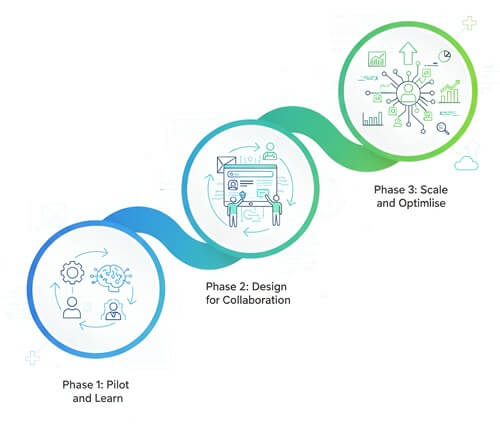
Phase 3: Scale and Optimise
Expand successful patterns to additional workflows whilst building organisational capabilities in collaborative intelligence. Develop training programmes, governance frameworks, and performance measurement systems that support sustained human-AI partnership.
The Competitive Imperative
Organisations that master ensuring human-AI collaboration gain sustainable competitive advantages. They achieve higher productivity without sacrificing quality, accelerate employee development, and maintain adaptability in rapidly changing markets. Perhaps most importantly, they create resilient systems that combine the best of human creativity and machine capability.
The companies leading this transformation aren’t asking whether AI will replace humans, they’re designing collaborative systems that make both more effective. They understand that the future belongs not to pure automation or traditional human-only processes, but to carefully orchestrated partnerships that unlock new levels of performance.
As AI capabilities continue advancing, the organisations that thrive will be those that perfect the art and science of collaborative intelligence. The question isn’t whether to adopt AI, but how to design human-AI partnerships that amplify your organisation’s unique strengths.
Ready to explore how collaborative intelligence can transform your organisation? Subscribe to our newsletter for insights on implementing human-AI partnerships that deliver measurable results whilst maintaining human agency and creativity at the centre of your operations. Alternatively check out our latest posts and projects.
References
[1] Dell’Acqua, F., McFowland, E., Mollick, E.R., Lifshitz-Assaf, H., Kellogg, K., Rajendran, S., Krayer, L., Candelon, F., & Lakhani, K.R. (2023). Navigating the Jagged Technological Frontier: Field Experimental Evidence on the Effects of AI on Knowledge Worker Productivity and Quality. Harvard Business Review. https://www.hbs.edu/faculty/Pages/item.aspx?num=64700
[2] Brynjolfsson, E., Li, D., & Raymond, L.R. (2023). Generative AI at Work. The Quarterly Journal of Economics, 140(2), 889-945. https://academic.oup.com/qje/article/140/2/889/7990658
[3] Vaccaro, M., Almaatouq, A., & Malone, T.W. (2024). When combinations of humans and AI are useful. Nature Human Behaviour, 8, 1515-1522. https://www.nature.com/articles/s41562-024-02024-1
[4] Dellermann, D., Ebel, P., Söllner, M., & Leimeister, J.M. (2019). Hybrid Intelligence. Business & Information Systems Engineering, 61, 637-643. https://aisel.aisnet.org/pacis2021/78/
[5] Akata, Z., Balliet, D., de Rijke, M., Dignum, F., Dignum, V., Eiben, G., Fokkens, A., Grossi, D., Hindriks, K., Hoos, H., Hung, H., Jonker, C., Monz, C., Neerincx, M., Oliehoek, F., Prakken, H., Schlobach, S., van der Gaag, L., van Harmelen, F., van Hoof, H., van Riemsdijk, B., van Wynsberghe, A., Verbrugge, R., Verheij, B., Vossen, P., & Welling, M. (2020). A Research Agenda for Hybrid Intelligence: Augmenting Human Intellect With Collaborative, Adaptive, Responsible, and Explainable Artificial Intelligence. Computer, 53(8), 18-28.
[6] ORMS Today Editorial Team. (2025). The Symbiotic Relationship of Humans and AI. ORMS Today. https://pubsonline.informs.org/do/10.1287/orms.2025.01.09/full/
[7] Amershi, S., Weld, D., Vorvoreanu, M., Fourney, A., Nushi, B., Collisson, P., Suh, J., Iqbal, S., Bennett, P.N., Inkpen, K., Teevan, J., Kikin-Gil, R., & Horvitz, E. (2019). Guidelines for Human-AI Interaction. Proceedings of the 2019 CHI Conference on Human Factors in Computing Systems. https://dl.acm.org/doi/10.1145/3290605.3300233